CASE STUDY

Optical Context MCP
The same PDF, up to 85 % less context: a published MCP package packs OCR-heavy pages into a few image bundles for vision LLMs – layout, tables and drawings stay intact, and a model decides the packing density itself.
- Role
- Concept, development and release
- Status
- Open source on PyPI, 5 releases
STARTING POINT
Problem
Scanned, OCR-heavy PDFs are expensive for vision LLMs: every page takes up context as its own image, and with longer documents the window is full before the model can even start. Plain text extraction is no answer either, because layout, tables and drawings are usually the part that matters.
HOW IT WORKS
Solution & architecture
Benefit
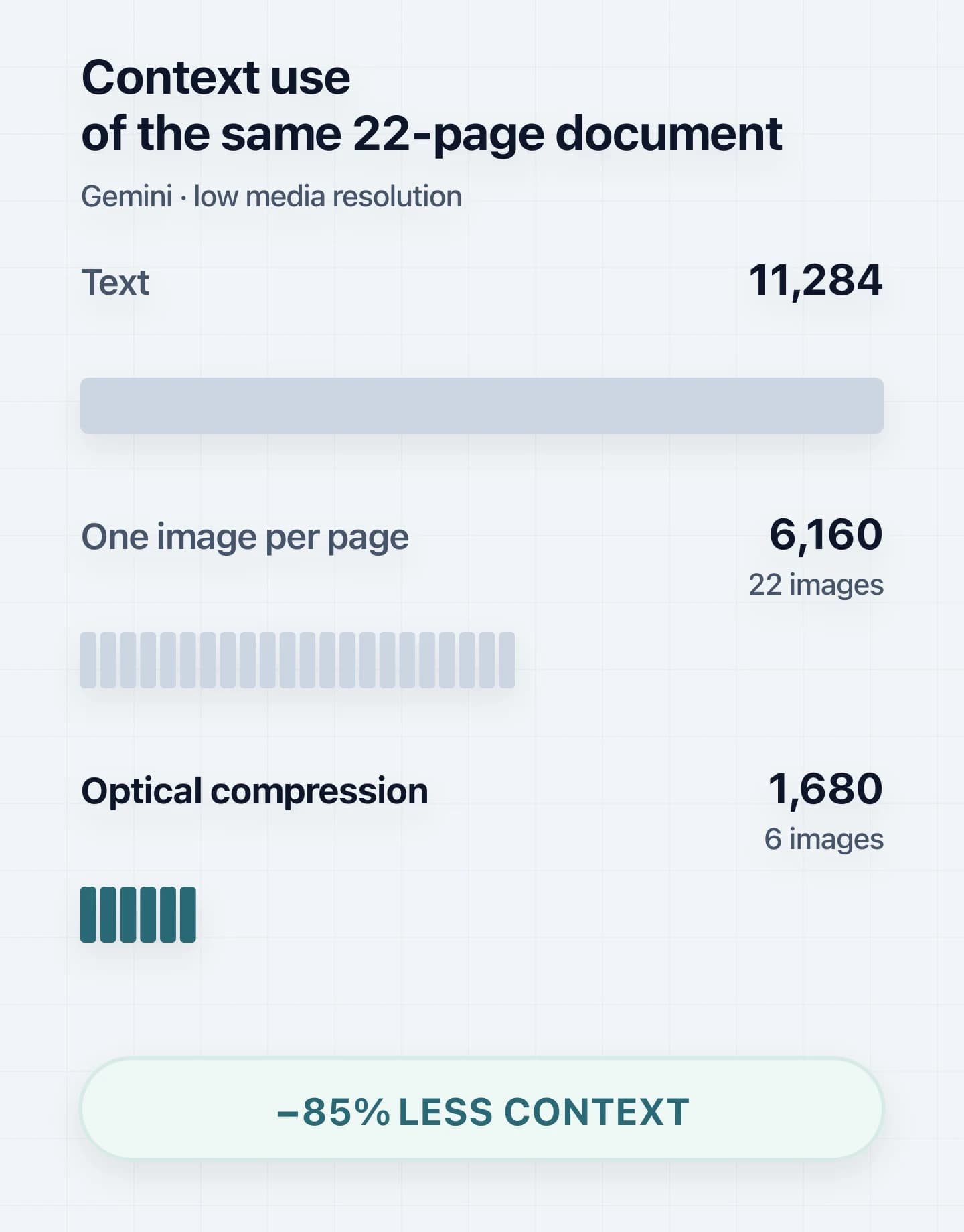
The same document, 15 % of the context
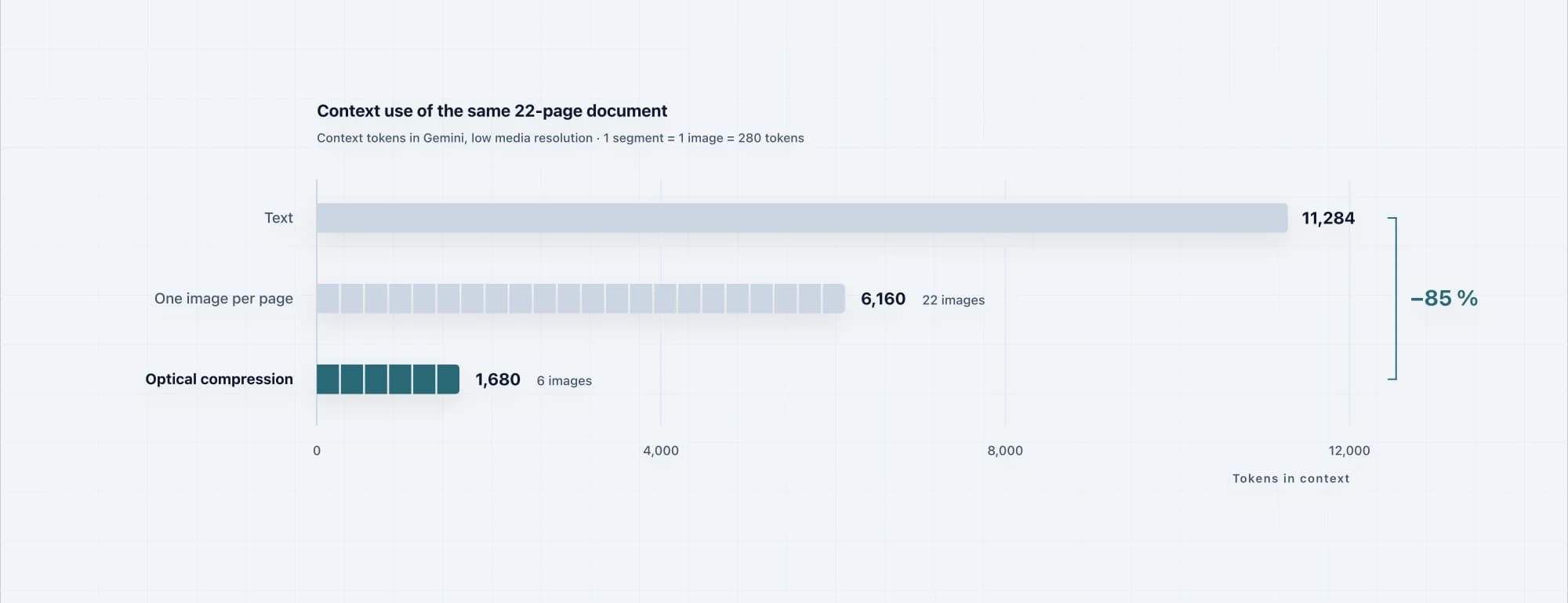
A 22-page paper costs 11,284 tokens as text and still 6,160 as one image per page. As six packed image bundles it is 1,680 – the document fits into a context window it did not fit into before, costs a fraction per request and stays readable as an image, tables and drawings included.
- 1,680 instead of 11,284 tokens for the same document
- 6 image bundles instead of 22 single page images
- Layout, tables and drawings stay intact
Compression
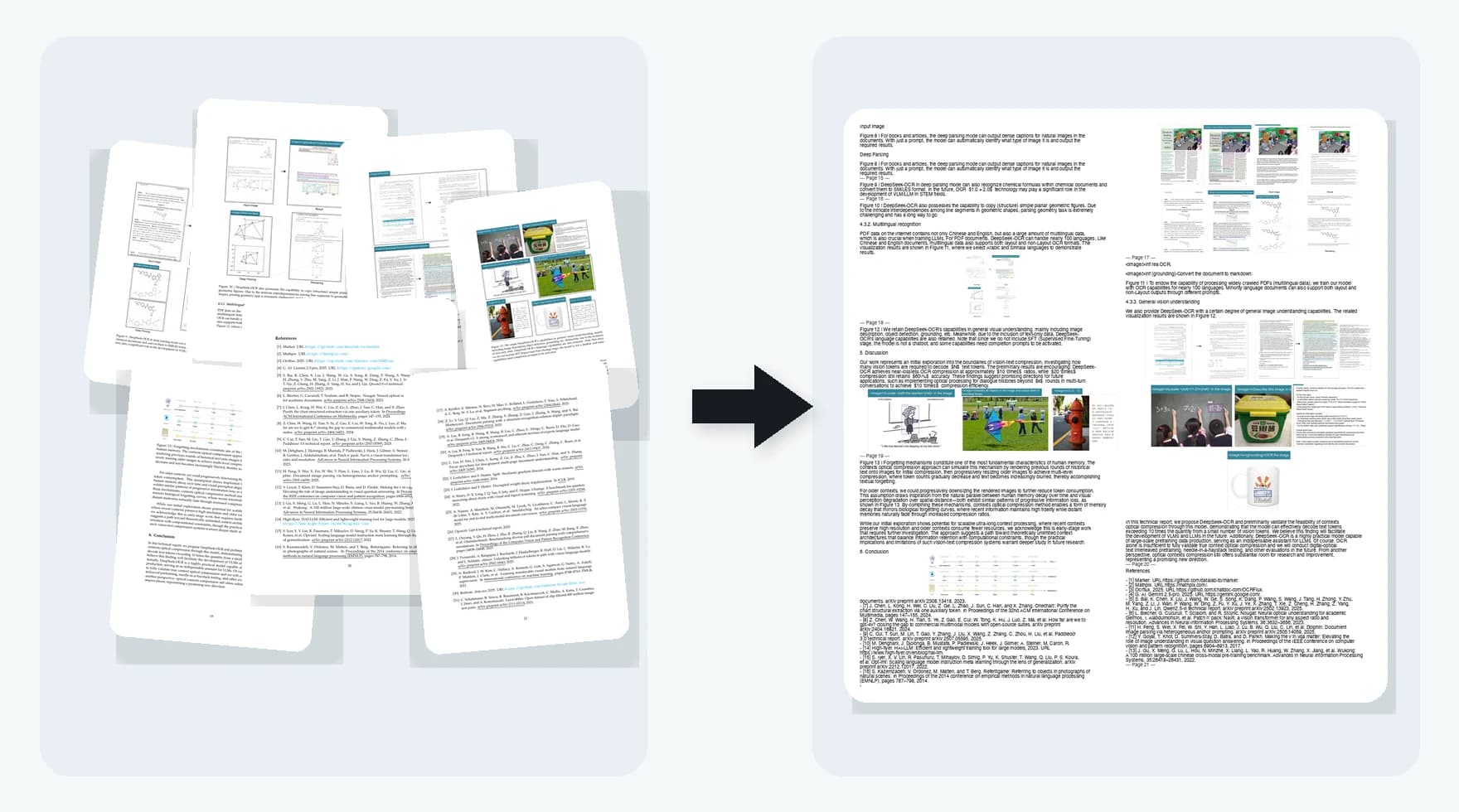
22 pages become six image bundles
A FastMCP server with three tools, which any MCP-capable client can plug in, runs the PDF through Mistral OCR and then packs the pages into image bundles that go to a vision LLM as a whole.
- 3 tools for any MCP-capable client
- Mistral OCR instead of plain text extraction
- Up to 85 % estimated context reduction on a 22-page test document
Model
A model decides how densely to pack
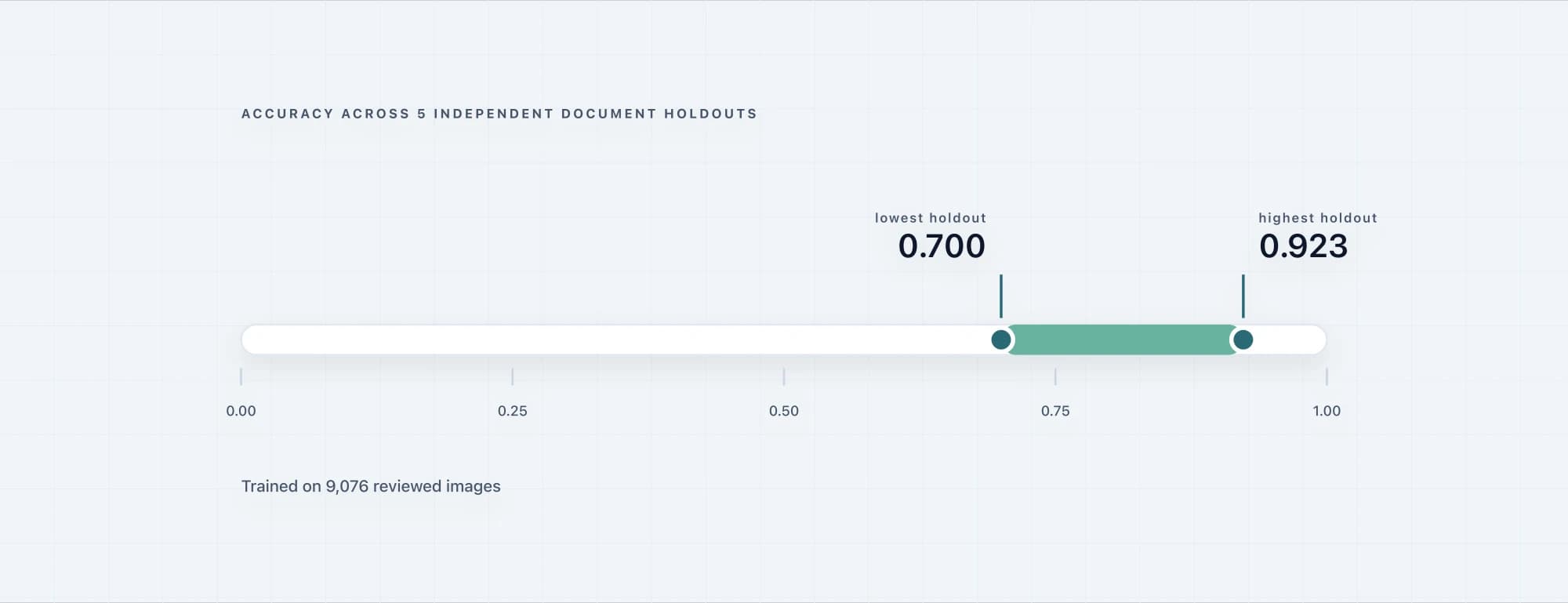
How densely pages can be packed before they stop being readable depends on the document. That call is not made by a fixed threshold but by a MobileNetV3 I trained on 9,076 reviewed images and evaluated on five independent document holdouts.
- 9,076 reviewed training images
- Accuracy 0.700–0.923 across 5 holdouts
- CI with trusted publishing, five releases so far
Limits
Not every page is worth turning into an image
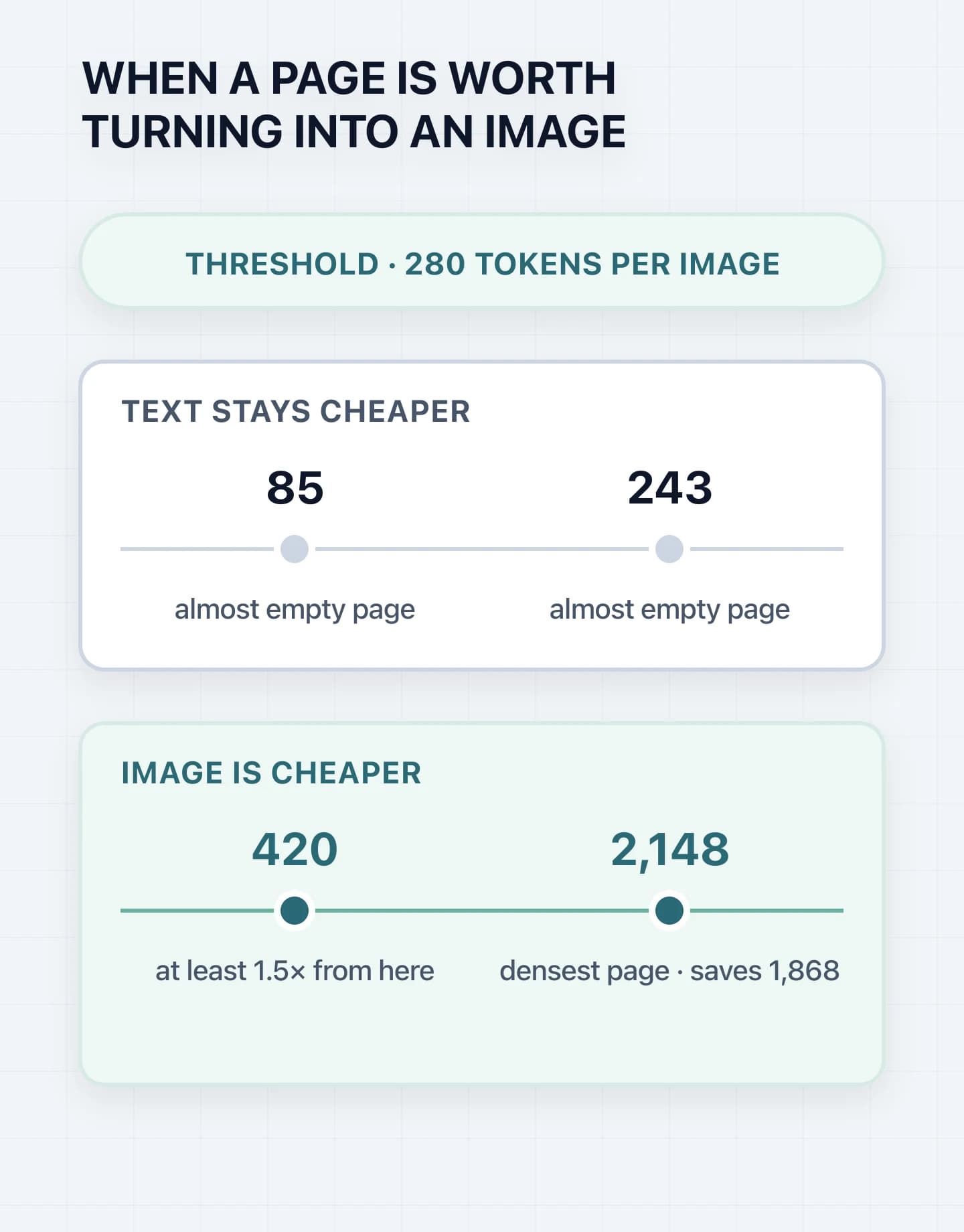
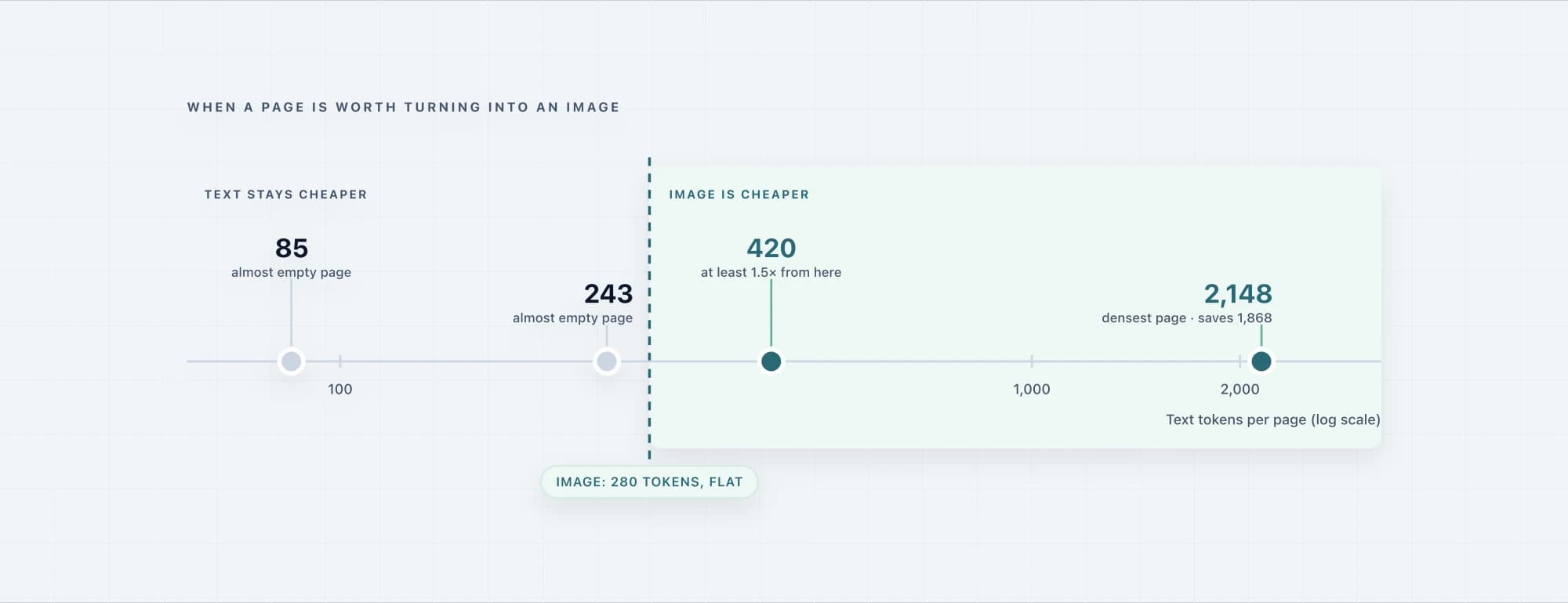
An image costs a flat 280 tokens, no matter how much is on it. So a page only pays off once its text costs more than that. In the test document 20 of 22 pages were above that line; the two exceptions were almost empty pages at the end. The densest page alone saved 1,868 tokens. The server does this arithmetic per page and only packs what pays off.
- Break-even at 280 text tokens per page
- from roughly 420 text tokens per page the image reliably pays off
- measured on one document – not a universal value
ARCHITECTURE
The path through the system
scanned or OCR-heavy
Mistral OCR
Page recognition
Sizing model
MobileNetV3 sets the packing density
Image bundles
several pages per image
Vision LLM
far less context per document
Interface
FastMCP server with 3 tools for any MCP client
Training
9,076 reviewed images, 5 independent document holdouts
Delivery: CI with trusted publishing to PyPI, 5 releases so far
Results
- less context for the same 22-page test document
- up to 85 %less context for the same 22-page test document
- images for the 22-page test document
- 6 instead of 22images for the 22-page test document
- reviewed training images for the sizing model
- 9,076reviewed training images for the sizing model
- accuracy across 5 independent document holdouts
- 0.700–0.923accuracy across 5 independent document holdouts
EVIDENCE & SCOPE
What is evidenced — and where the claim ends
These four fields separate my contribution, the project context, the measurement basis and the limits of the results.
- My contribution
- Concept, development and release of the FastMCP server, OCR and packing pipeline, and MobileNetV3 sizing model. Delivery to PyPI is automated through trusted publishing.
- Team & context
- The package, source code and research repository are linked publicly, and five releases document publication. The available project data does not state a team size, so none is claimed here.
- Measurement basis
- The sizing model was trained on 9,076 reviewed images and evaluated on five independent document holdouts. Accuracy ranges from 0.700 to 0.923 by holdout; context reduction was estimated on one 22-page test document.
- Limitations
- The accuracy range shows that results depend on the document. Up to 85 % context reduction is an estimate from one 22-page test document, not a universal value for every PDF; it does not establish general vision-LLM answer quality.
BUILT WITH
Tech stack
- Python
- FastMCP
- Mistral OCR
- PyTorch
- MobileNetV3
- Pillow
- GitHub Actions
Does this match what you have in mind?
I build systems that are meant to run in production, not just to demo. If that matches what you have in mind, get in touch.
All case studies